

What is a banister?
A banister, sometimes spelled bannister, is a core component of a staircase. It plays an essential role in safety, structure and design, helping people move confidently between floors while also shaping the visual character of a space.
Because staircase terminology is often used interchangeably, many homeowners are unsure exactly what a banister is and how it differs from other staircase elements. This guide explains what a banister is, how it fits into the wider staircase structure and what to consider when installing or replacing one.
Here at Handrail Creations, we are experts in bespoke handrail design, manufacture and installation across the UK. So we’ve compiled everything you need to know about handrails into a helpful guide below.
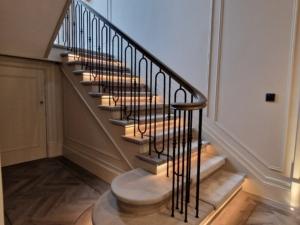
The purpose of a banister in a staircase
The primary function of a banister is safety. It provides a secure point of contact when ascending or descending stairs, helping to prevent slips and falls.
Beyond safety, a banister also:
- Adds structural support to the staircase
- Defines the edge of open staircases
- Influences the overall design style of the space
- Connects different floors visually and practically
A well-designed banister balances comfort, durability and aesthetics, making it a vital element of staircase planning.
How a banister fits into the staircase structure
A banister does not exist in isolation. It works as part of a wider system made up of several key staircase components.
The banister itself is the handrail, which is supported by vertical elements called balusters or spindles. These are fixed into the staircase and help prevent falls through the open side. At the start and end of the staircase, larger posts known as newel posts anchor the structure and provide strength.
In some modern designs, glass panels or metal infills replace traditional spindles, but the banister remains the main point of support.
Materials commonly used for banisters
Banisters can be made from a wide range of materials, depending on the style and demands of the staircase.
Timber banisters remain the most popular choice due to their warmth, durability and versatility. Softwoods offer a more affordable option, while hardwoods such as oak, ash and walnut provide longevity and a premium finish.
Metal banisters are often used in contemporary or industrial spaces, while glass is chosen for its ability to maximise light and openness. Many staircases combine materials to create contrast and visual interest.

Banister design and visual impact
The banister plays a significant role in how a staircase looks and feels. Its profile, finish and material choice can dramatically influence the overall impression of a space.
Slim, clean profiles suit modern interiors, while shaped or carved handrails complement traditional homes. Painted finishes can add contrast, while natural timber highlights craftsmanship and texture.
When designed thoughtfully, a banister becomes a feature rather than a purely functional element.
Banister installation and accuracy
Accurate measurement and installation are critical for a banister to perform properly. Poorly fitted handrails can feel uncomfortable, look uneven or fail to meet safety standards.
Straight staircases may allow for simpler installation, but curved, spiral or multi-level staircases require specialist surveying and manufacturing. Precision is especially important when replacing an existing banister to ensure a seamless fit.
At Handrail Creations, we use digital surveys and CNC machining to ensure every banister is manufactured to exact measurements before installation, reducing disruption on site.
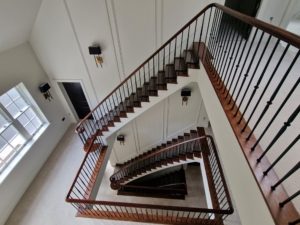
Maintaining and updating a banister
Regular maintenance helps extend the life of a banister. Cleaning, minor refinishing and repainting can keep it looking its best.
Frequently asked questions about banisters
What is a banister?
A banister is the handrail of a staircase that people hold for support when moving up or down the stairs. It is a key safety feature and also contributes to the staircase’s overall design.
Is a banister the same as a balustrade?
No, a banister refers specifically to the handrail, while a balustrade describes the entire protective structure, including the handrail, balusters, newel posts and sometimes a bottom rail.
What is the end of a banister called?
The ends of a banister are supported by newel posts. These larger posts provide structural strength and can be decorative as well as functional.
How tall should a banister be in the UK?
In both residential and commercial properties, banisters must be at least 900mm high when measured from the pitch line of the stairs, in line with UK Building Regulations. To learn more, make sure you consult Part K of The Building Regulations 2010.
Do all staircases need a banister?
Most staircases require a banister when there is a drop of more than 600mm. Wider staircases may require banisters on both sides for safety.
Can I replace a banister without replacing the whole staircase?
Yes. In many cases, a banister can be replaced independently. However, complex staircases may require bespoke design to ensure the new handrail fits correctly.
Are bespoke banisters worth it?
Bespoke banisters offer a precise fit, greater design flexibility and a higher quality finish, particularly for curved or feature staircases. They are often a long-term investment in both safety and aesthetics.
What is the best paint to use on a banister?
We would recommend using a paint that’s specifically formulated for wooden surfaces (if you’ve got a wooden handrail) to improve durability and longevity. Since stairs are a high-traffic area, we would also recommend using a gloss finish, as this type of paint should make it easier to wipe your wooden handrail clean.
Should I install a banister myself or use a professional?
Simple, straight banisters can sometimes be installed as a DIY project. For curved staircases, compliance requirements or high-quality finishes, professional installation ensures accuracy and peace of mind.
Speak to the banister specialists
Understanding what a banister is and how it fits into your staircase helps you make informed decisions about safety and design. Handrail Creations provides a complete service, from digital surveying and bespoke design through to precision manufacturing and expert installation. If you are planning a staircase project or need advice, get in touch with our team to discuss your requirements.


Trackbacks & Pingbacks
[…] it comes to cleaning wooden banisters – referring to the handrail and sometimes also the uprights or spindles supporting the handrail […]
Leave a Reply
Want to join the discussion?Feel free to contribute!