Accessible handrails: The building regulations you need to know
When it comes to staircase safety in the UK, accessible handrails are a legal and practical requirement to consider. Whether you’re working on a commercial development, upgrading a public building, or planning an inclusive accessible home design, understanding the relevant building regulations is essential.
In the UK, the primary guidance for handrails is provided by Approved Document M (Access to and Use of Buildings) and Approved Document K (Protection from Falling, Collision and Impact). Together, these documents set out how handrails should be positioned, shaped and constructed to ensure they are safe, usable and fully aligned with DDA compliance standards.
However, compliance is not just about meeting dimensions. Good handrail design integrates regulatory requirements seamlessly into the overall architectural vision, balancing accessibility with craftsmanship and aesthetics.
Understanding the core requirements
The starting point for any compliant stair handrail design is height. Regulations typically require handrails to be positioned between 900mm and 1000mm above the pitch line of the stairs, or the surface of a ramp or landing. In some contexts, particularly on landings, heights of up to 1100mm may apply. This range ensures that users can comfortably grip the rail whether ascending or descending. In the context of accessible handrails, the correct height is fundamental, particularly for users with limited mobility or balance concerns.
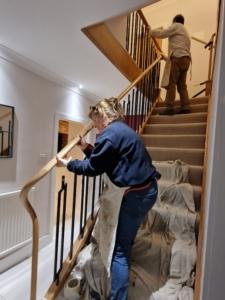
Continuity is equally important. A compliant rail should run uninterrupted along the full length of the staircase or ramp. Breaks in the rail, whether caused by newel posts or structural transitions, can disrupt support at critical points. For this reason, continuity forms a core part of effective DDA handrail design, ensuring that users have consistent support from start to finish.
Another vital handrail requirement is known as the 100mm gap rule or the “baby’s head rule”. In both residential and non-residential buildings, the gaps between balusters on staircases and balconies must not exceed 100mm. This ensures that a 100mm sphere (or baby’s head) will not fall through or get stuck in the balustrade.
Finally, for any staircase wider than 1 metre in either a dwelling or a public building, there must be handrails on both sides rather than just one.
Why handrail extensions matter (non-dwellings)
One of the most frequently overlooked elements of DDA compliance in non-residential buildings is the requirement for handrail extensions. Regulations state that handrails should extend horizontally by at least 300mm beyond the top and bottom of a flight of stairs or ramp. This allows users to stabilise themselves before stepping onto or off the change in level.

Without this extension, the user may lose support at precisely the moment they need it most. From a regulatory standpoint, these small details are critical and demonstrate how thoughtful handrail design goes beyond appearance and requires real-world usability.
However, the regulations for residential buildings are different. Handrail extensions beyond the stairs are not required in dwellings, and you actually don’t need a handrail for the first two steps of your staircase.
Grip, profile and comfort (non-dwellings)
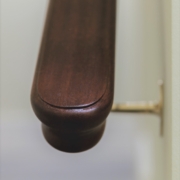
The physical shape of a handrail plays a significant role in accessibility. Approved guidance for non-residential buildings recommends a circular profile between 40mm and 50mm in diameter. Where non-circular profiles are used, they should allow an equivalent firm grip and generally not exceed 50mm in width. The goal is simple. The hand must be able to wrap securely around the rail. In a well-executed stair handrail design, comfort and ergonomics are prioritised alongside aesthetics.
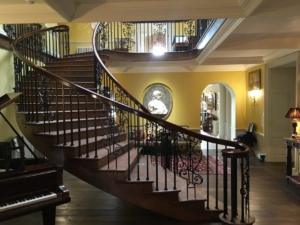
Wall clearance is also essential. There should typically be a gap of 50mm to 75mm between the handrail and the adjacent wall. Without sufficient clearance, fingers cannot fully grip the rail, compromising both comfort and compliance.
It’s worth noting that private dwellings can have any handrail shape or design, all of which we can manufacture and install here at Handrail Creations due to our use of both CNC machining for precise measurements and traditional hand-carving techniques for unique finishing details. This flexibility extends beyond handrail profiles to the overall staircase design, where residential projects allow greater freedom in geometry, including variations in width, bespoke layouts and features such as extra-tall landings or more generous circulation spaces. However, if accessibility is your primary concern during home construction or renovation, you may prefer a shape that enables better grip, ensuring the design balances both usability and aesthetics whilst remaining appropriate to the character of the home.
Materials and surface considerations
Material choice is often viewed as purely stylistic, but for accessible handrails (in public buildings in particular), it has functional implications. Handrails must be easy to grip and should not feel excessively cold to the touch, particularly in external environments. Timber, coated metals and certain stainless steel finishes are commonly specified in compliant DDA handrail design because they balance durability with comfort.
Equally important is visual contrast. Approved Document M emphasises that handrails should be visually distinguishable from their background in public buildings, but this may also be recommended in homes, especially for elderly or visually impaired residents. This contrast supports visually impaired users and forms an important part of inclusive accessible home design and public building standards.
Structural strength and fixing
No matter how elegant the finish, a handrail must be structurally sound. Regulations require that handrails be securely fixed and capable of resisting applied loads without excessive deflection. In practice, this means the fixing system, bracket spacing and structural anchoring must all be carefully considered. High-quality handrail design addresses these structural requirements from the outset, ensuring long-term reliability as well as regulatory compliance.

Additional considerations for ramps and public spaces
Where external steps or ramps are involved, particularly in public buildings, requirements often become more robust.
In many cases, the following conditions must be adhered to:
- Handrails are required on both sides
- A secondary, lower rail (around 600mm-750mm) may be recommended
- Additional emphasis is placed on durability and visibility
These measures enhance usability for children, wheelchair users and individuals requiring additional support. As accessibility becomes a central consideration in contemporary architecture, inclusive design is fundamental.
Accessible design in residential projects
While Parts M and K are often associated with commercial buildings, residential projects are increasingly incorporating accessible principles from the outset. Future-proofing a home through inclusive stair handrail design allows properties to remain usable as occupants’ needs change over time.
In modern accessible home design, compliance does not need to detract from visual appeal. Instead, well-integrated accessible handrails enhance both safety and architectural refinement. When properly detailed, they become a seamless extension of the staircase rather than a visible afterthought.

FAQS
How do I design a staircase in a home so that it meets accessibility standards?
Start by considering usability from the outset. Correct handrail height, continuous support, compliant grip profiles and appropriate extensions are key if accessibility is a primary concern in a dwelling. Integrating these requirements early in the handrail design process avoids costly adjustments later.
What are the latest trends in interior design when it comes to accessibility?
Current interior design trends prioritise inclusive and adaptable spaces. Rather than treating accessibility as an add-on, many designers now incorporate compliant stair handrail design principles into contemporary interiors from the beginning.
Do accessible handrails have to look institutional?
Not at all. A well-considered DDA handrail design can be elegant and refined. With the right materials and detailing, compliance and aesthetics can work together seamlessly.
Are the regulations different for commercial buildings?
The core dimensional guidance remains mostly consistent (with some extra regulations as described above), but enforcement is stricter in commercial and public settings. Projects must demonstrate clear DDA compliance, particularly regarding continuity, extensions and dual handrails.
Can accessible handrails be used in heritage properties?
Yes. Sensitive handrail design can complement both contemporary and classic architecture, allowing accessibility improvements without compromising historical character.
Is visual contrast mandatory?
Yes – in public buildings. Regulations require sufficient contrast between the handrail and surrounding surfaces to assist visually impaired users.
Why is continuity so important?
Continuous support ensures users are never without assistance during ascent or descent – a central principle of effective accessible handrails.
What materials are best for accessible handrails?
Materials should provide a secure grip, durability and comfort. Timber and coated metal systems are commonly specified in compliant installations.
How far should handrails extend beyond stairs?
Typically, at least 300mm horizontally beyond the top and bottom of the flight for public buildings.
Can bespoke handrails still meet all regulations?
Absolutely. Bespoke solutions can be engineered to meet every aspect of DDA compliance while achieving a refined and architectural finish.
Design accessible handrails with confidence
Achieving compliance does not mean compromising on craftsmanship. At Handrail Creations, we understand that regulatory requirements are only one part of the equation. The true measure of success lies in delivering bespoke, accessible handrails that meet requirements while enhancing the architectural quality of the space.
From precision-engineered stair handrail design solutions to complex curved installations, our team ensures every project aligns with both structural standards and design intent. Whether you’re working within contemporary architecture, adapting an existing building, or pursuing fully inclusive accessible home design, we provide expert guidance and bespoke solutions tailored to your requirements.
If your project requires compliant, beautifully executed handrails, our team is ready to help you deliver accessibility with confidence and craftsmanship. Contact us today to discuss your project.